

Anne Frank’s specific body was never individually identified or recovered. She died of typhus in the Bergen-Belsen concentration camp in February or March 1945, and her remains were buried in a mass grave, making it impossible to locate her specific burial spot. A memorial stone in the camp marks her death, but it is not a grave site.
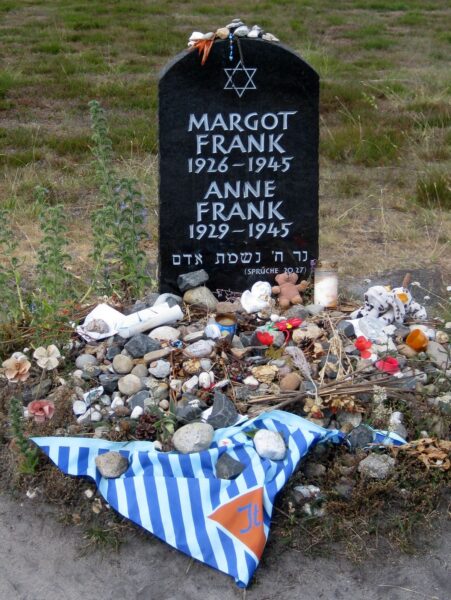
Anne Frank’s gravestone at Belsen Concentration Camp
Were Anne Frank’s Remains Found?
The question of whether Anne Frank’s remains have been discovered remains a subject of great interest and sorrow for many around the world. Anne Frank, the young Jewish girl whose diary became one of the most poignant symbols of the Holocaust, disappeared from history in the final months of World War II, leaving behind a legacy that continues to educate and inspire generations.
The Disappearance and Death
Anne Frank and her family went into hiding in 1942 in a secret annex in Amsterdam to escape Nazi persecution. Despite the constant threat, Anne kept a detailed diary, capturing her thoughts, fears, and hopes during her time in hiding. In August 1944, their hiding place was betrayed, and Anne, her family, and others were deported to concentration camps.
Anne was initially sent to Auschwitz and later transferred to the Bergen-Belsen camp in Germany. Tragically, she contracted typhus and died in early 1945, just weeks before the camp was liberated by British forces. She was approximately 15 years old. Her exact date of death remains uncertain, but most historians agree she succumbed in late February or early March 1945.
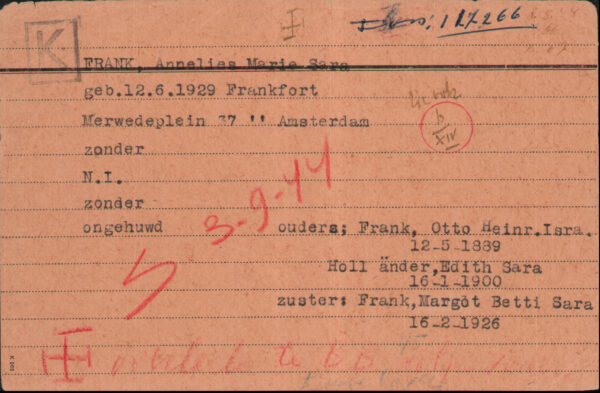
The registration card of Anne Frank. Many have the date of the holder’s deportation to a concentration camp written in red pencil.
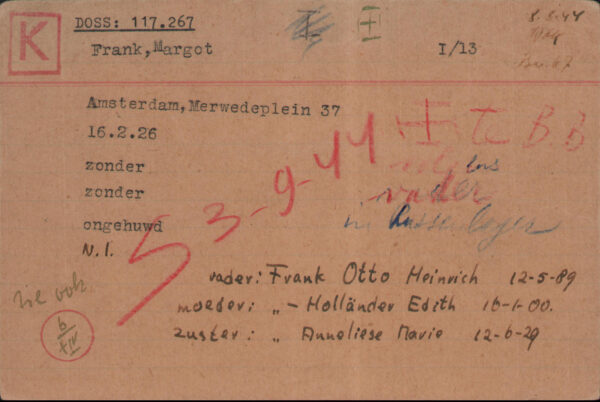
The registration card of Margot Frank. Many have the date of the holder’s deportation to a concentration camp written in red pencil.
Were Her Remains Found?
For decades, the precise location of Anne Frank’s remains has been unknown. She was buried in the mass graves at Bergen-Belsen, a site that saw the deaths of thousands of prisoners due to disease, starvation, and brutal conditions. The camp’s mass graves were often unmarked, and records from the camp’s final months were incomplete or destroyed.
In 1945, Bergen-Belsen was liberated by British troops, who found a scene of utter devastation. The remains of countless victims, including Anne Frank’s, were left in unmarked graves or mass pits. The chaos and destruction at the end of the war made it impossible to identify individual remains conclusively.
Post-War Investigations and Research
Over the years, numerous efforts have been made to locate Anne Frank’s remains. Researchers, historians, and forensic experts have examined camp records, testimonies, and archaeological evidence. Some have speculated that her remains might have been moved or lost over time, given the camp’s chaotic final days.
In 2015, a significant breakthrough occurred when an archaeological investigation was conducted at Bergen-Belsen, motivated by new historical evidence suggesting that the camp’s mass graves might have been disturbed or that some remains could still be identified. However, no conclusive evidence emerged linking any remains directly to Anne Frank.
Annelies Marie Frank
Birthplace and Date Frankfurt am Main, 12-6-1929
Deathplace and Date Bergen-Belsen, 31-3-1945
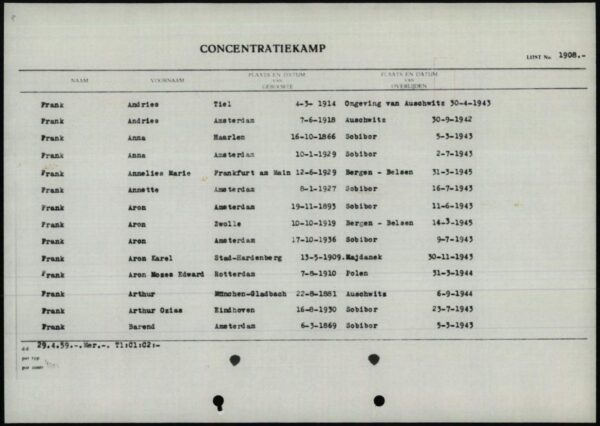
This document is a historical record from a concentration camp listing individuals, primarily named Frank, along with their birth locations, dates, and locations and dates of death. The list includes names associated with major concentration and extermination camps during the Holocaust, such as Auschwitz, Bergen-Belsen, and Sobibor.
Why Is It Difficult to Confirm?
Several factors contribute to the difficulty in confirming Anne Frank’s remains:
- Lack of Specific Records: The chaos at Bergen-Belsen meant that detailed records of individual burials were not kept or were destroyed.
- Mass Graves and Unmarked Burial Sites: The camp’s mass graves were often unmarked, and the remains were subject to decomposition, making identification impossible.
- Time and Decomposition: Decades have passed since the war, and natural decomposition, combined with potential disturbances of graves, complicate any forensic identification.
- Absence of Personal Remains: No personal artifacts or remains have been definitively linked to Anne Frank in the camp or elsewhere.
Official death certificate of Annelies Marie Frank
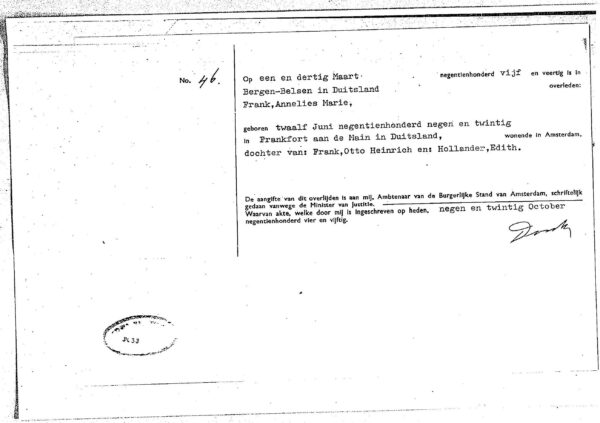
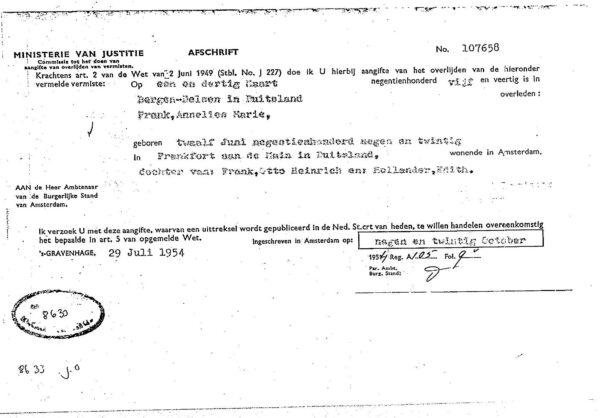
The death certificate states Annelies Marie Frank born in Frankfurt am Main, Germany 12 June 1929 daughter of Otto Heinrich Frank and Edith Hollander died in Bergen-Belsen Germany 31 March 1945 certificate issued 29101954
Official Red Cross declaration of Anne Frank’s death, May 5, 1954.
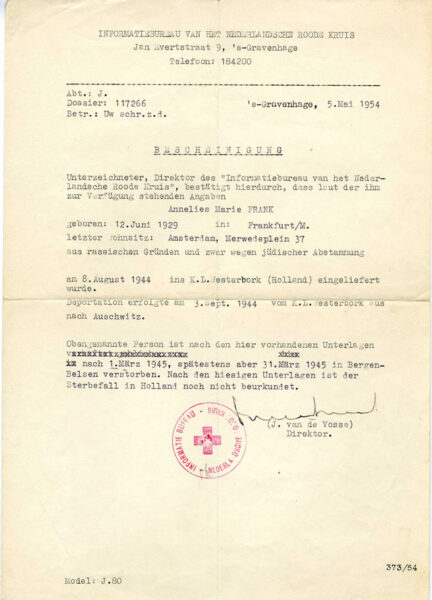
Official notice from the Red Cross from 1954 that Anne Frank died in the Bergen-Belsen concentration camp, somewhere between 1 and 31 March, 1945. Otto Frank had already heard of both his daughters’ deaths in the summer of 1945, from a nurse who was in the same camp as Anne en Margot Frank. It became clear later that the date of death must have been between late February and early March, 1945. Anne died a few days after her sister Margot.
Official Red Cross declaration of Margot Frank’s death, May 5,1954.
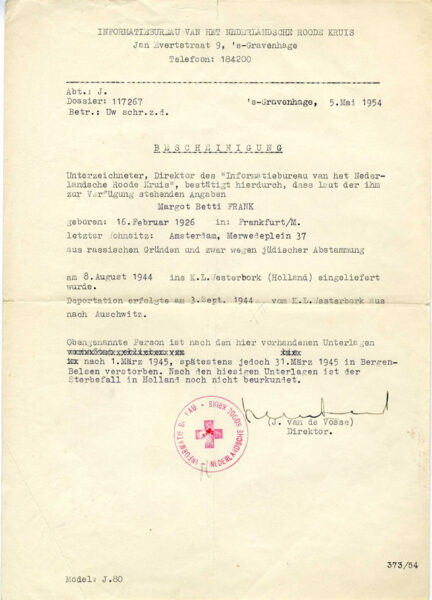
Official notice from the Red Cross from 1954 that Margot Frank died in the Bergen-Belsen concentration camp, somewhere between 1 and 31 March, 1945. Otto Frank had already heard of both his daughters’ deaths in the summer of 1945, from a nurse who was in the same camp as Anne en Margot Frank. It became clear later that the date of death must have been between late February and early March, 1945. Margot died a few days before her sister Anne.

The Current Status
As of today, there is no verified evidence that Anne Frank’s remains have been recovered or identified. Her final resting place remains unknown, and her death is officially recorded as occurring in Bergen-Belsen in early 1945. The inability to locate her remains has added to the profound tragedy surrounding her story—her voice lives through her diary, but her physical remains have yet to be found.
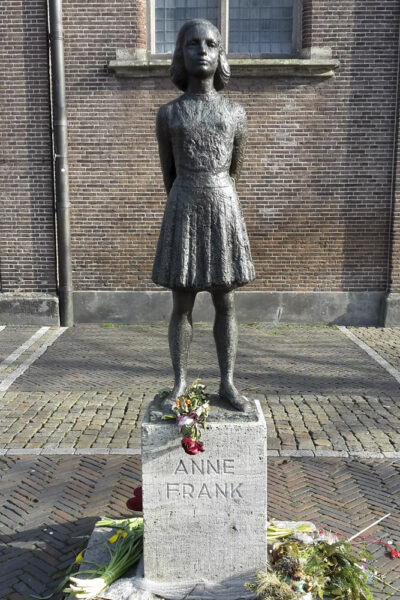
The Significance of Remembrance
While the question of her remains persists, Anne Frank’s legacy continues to thrive through her writings and the museum dedicated to her memory in Amsterdam. Her diary serves as a powerful reminder of the human cost of hatred and intolerance and underscores the importance of remembrance and education.
In summary, Anne Frank’s remains have not been found or conclusively identified. The chaos of Bergen-Belsen and the destruction wrought by the Holocaust have left her final resting place shrouded in mystery. Nevertheless, her story endures as a testament to resilience and the enduring need to remember those who suffered and perished during one of history’s darkest chapters.